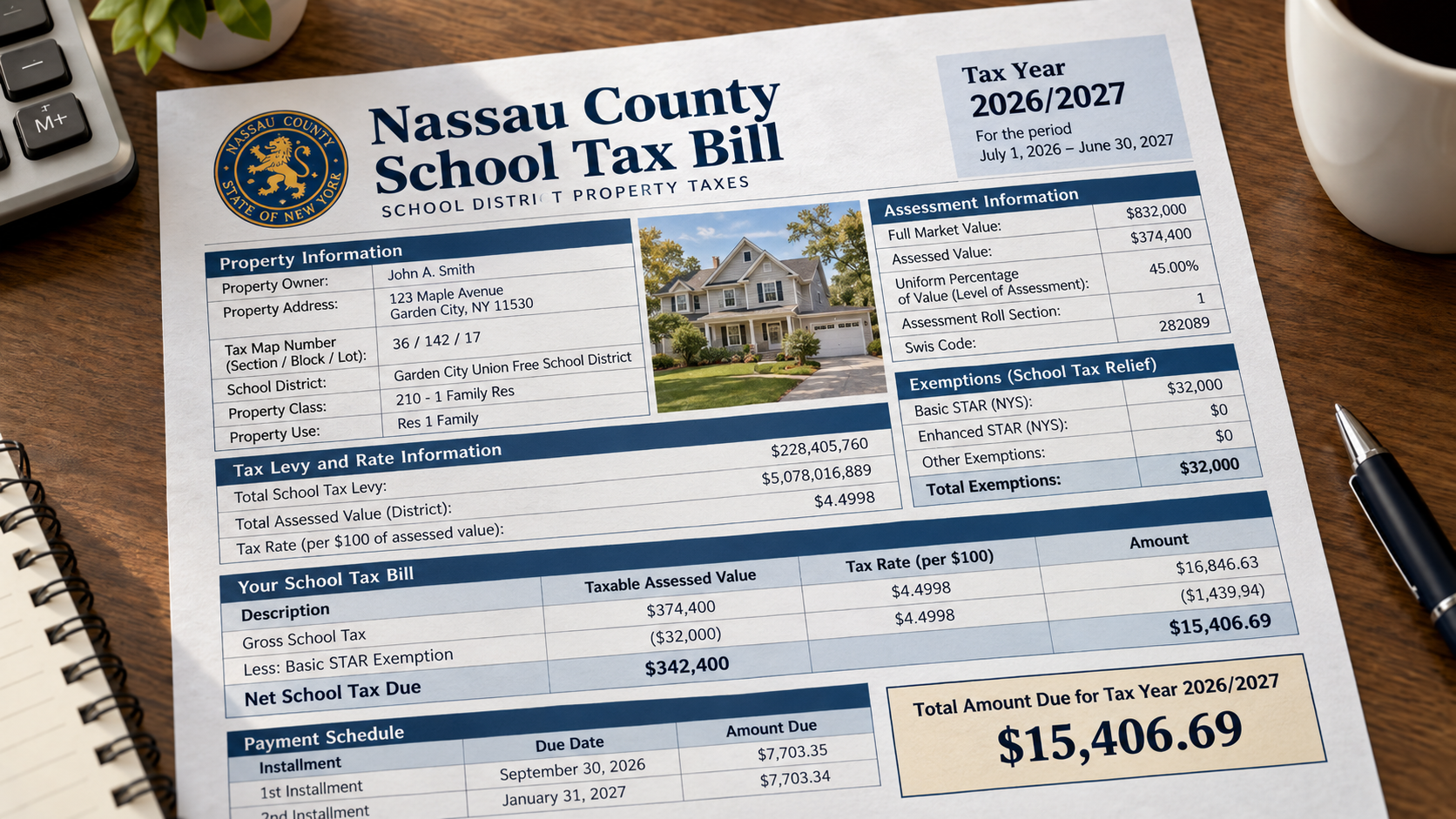
Every year, Long Island homeowners open their tax bills and ask the same question: “I didn’t renovate. I didn’t add square footage. My home didn’t suddenly become more valuable. So why did my property taxes go up again?”
It’s a fair question, and the frustration behind it is justified. Many property owners assume taxes rise only when a home’s value increases; however, in New York, that assumption is often wrong.
Understanding why taxes increase even when nothing changes is the first step toward stopping the cycle.
Property Taxes Are Not Based Solely on Your Home’s Change in Value
One of the biggest misconceptions homeowners have is that property taxes rise only because their home is worth more. In reality, a tax bill is driven by several factors, many of which have nothing to do with the property itself. Taxes are affected by the assessed value placed on the home, the overall tax levy adopted by school districts and local municipalities, changes in tax rates, and how that tax burden is allocated across the broader tax base.
If your home’s market value stays flat, or even decreases, your taxes can still increase if other variables move against you.
How School District Budgets Drive Tax Increases
On Long Island, school taxes make up the largest portion of most tax bills. When a school district increases its budget, it needs to collect more revenue. That revenue is spread across all taxable properties in the district. If your assessment remains high relative to others, your share of that burden could be greater than your neighbors’.
This is why homeowners often see taxes rise even in stable or declining markets. The issue is not that your home suddenly became more valuable. It is that your assessment was never adjusted downward to reflect reality.
The Problem with Assessments That Roll Forward
In many New York jurisdictions, assessments carry forward year after year unless they are challenged. If an assessment was too high five or ten years ago and no grievance was filed, that inflated number often becomes the foundation for every future tax bill. Over time, the gap between assessed value and true market value can widen. Doing nothing allows that over-assessment to compound.
Why Your Neighbor’s Taxes May Be Going Up Less Than Yours
Homeowners often compare tax increases with neighbors and assume the system is arbitrary. In reality, differences often come down to who filed grievances and when.
If your neighbor successfully reduced their assessment in a prior year and you did not, your taxes may increase at a faster rate even if the homes are similar. Over time, these disparities become more pronounced.
This is one of the main reasons two nearly identical homes on the same block can end up with very different tax bills.
Why Waiting Rarely Fixes the Problem
Many homeowners hope tax increases will “correct themselves.” In New York, that rarely happens. Municipalities do not automatically lower assessments simply because market conditions soften. Without a grievance, an inflated assessment usually stays in place.
Waiting often means paying higher taxes year after year, even when there is a strong basis for a reduction.
How a Tax Grievance Addresses the Real Issue
A tax grievance challenges the assessed value of your property relative to its fair market value and comparable properties. When successful, it does more than reduce taxes for one year. It can reset the assessment to a fairer level, which helps control future increases. The goal is not just to react to a single tax bill. It is to correct the underlying number driving those bills.
Why Attorney Review Matters
Not every assessment is wrong, and not every tax increase justifies a grievance. The key is knowing when the numbers are truly out of line. An experienced tax grievance attorney reviews your current assessment, comparable sales and assessments, prior grievance history, and local assessment practices.
Just as importantly, a good attorney will tell you when filing does not make sense. At Blodnick, Fazio & Clark, we regularly advise clients not to file when the facts do not support it. That honesty is what makes the process worthwhile when a grievance is filed.
Bottom Line
If your property taxes keep going up even though nothing about your home has changed, the problem is rarely your house. More often, it is an assessment that was never corrected. Left unchallenged, that assessment can continue to drive higher tax bills year after year.
Request a Free Property Tax Review Today
If you are frustrated by rising property taxes and want to know whether your assessment is part of the problem, we offer a free, no-obligation property tax review.
We represent residential and commercial property owners throughout Suffolk County, Nassau County, New York City, and Upstate New York, and we focus on correcting over-assessments before they turn into long-term overpayment.
Contact us today to request your free property tax review today and find out whether your taxes are increasing for reasons that can be fixed.