How To Tell If Your Property Is Overassessed
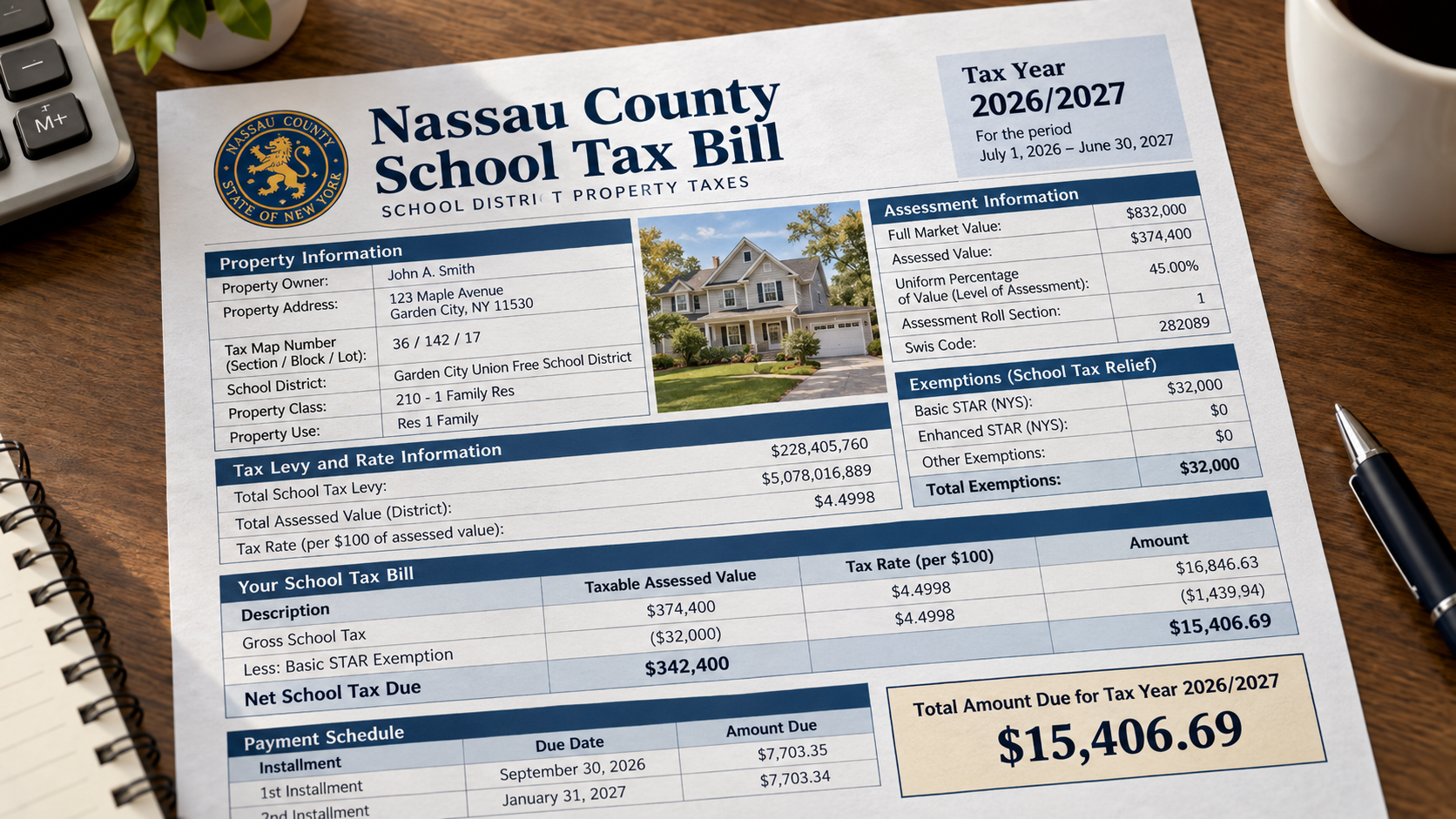
A high property tax bill is a reason to review your assessment. Determining whether you are overpaying requires a closer look at your home, the assessment assigned to it, and the sales evidence supporting its value. If your Nassau County property assessment is excessive, a tax grievance may help reduce the taxes attributable to that assessment. You should not wait for another tax increase to investigate.
The next Nassau County tax grievance filing period runs January 4 through March 1, 2027, for the 2028/29 assessment. Here is what homeowners should review before that deadline.
What Does It Mean for a Nassau County Home to Be Overassessed?
An overassessment exists when the assessment exceeds the property’s value. Nassau County assesses property at a fraction of its market value. The assessed value is therefore different from the price your home might sell for. A meaningful review considers the assessment, the correct assessment ratio which is often not the same level of assessment Nassau County publishes on its website, and a evidenced backed estimate of your home’s market value.
For homeowners in
Plainview,
Massapequa,
Hicksville,
Merrick,
Garden City, and throughout Nassau County, the question is whether the assessment fairly reflects the particular property.
Five Reasons to Review Your Nassau County Property Assessment
1. Similar Homes Have Sold for Less Than the Value Your Assessment Implies
Recent sales can help establish whether your home’s assessment is excessive. The strongest comparisons involve properties similar in location, living area, lot size, age, style, and condition. A larger renovated home may be a poor comparison for a smaller home that needs substantial work, even if they are on the same street. Differences in school district and immediate surroundings can also affect value.
2. Your Home Needs Work That Affects What a Buyer Would Pay
A valuation should account for the property’s actual condition. A house with significant water damage, structural concerns, or outdated systems may have a different market value from a comparable house in excellent condition. Photographs, inspection reports, and contractor estimates can help explain those differences. Keep records showing when a condition existed, because the relevant valuation date matters. Repair costs do not automatically translate into an equal assessment reduction. The issue is how the condition affects market value.
3. Nassau County’s Property Records Describe a Different Home
Review your home’s information as noted in the
Nassau County Land Records Viewer. Check the living area, lot size, number of bathrooms, basement, garage, and other listed features. An overstated living area or an improvement incorrectly attributed to your property deserves attention. Gather reliable supporting documents, such as a survey, plans, or professional measurements.
Correcting a property record and challenging an assessment involve separate procedures. Contacting the Department of Assessment about an error should not be treated as a substitute for preserving your grievance rights. Pursuing both avenues for relief may be justified.
4. You Recently Purchased the Home for Less Than the Assessment Appears to Support
A recent purchase may provide useful evidence, particularly when the property was openly marketed and the buyer and seller acted independently. In that scenario, keep the contract, closing documents, listing information, and any appraisal or inspection report. Those materials can help explain both the price and the property’s condition.
The purchase price does not automatically control the assessment or guarantee a successful grievance. The transaction’s timing, circumstances, and any subsequent improvements need to be considered. Still, a meaningful gap between an actual sale and the value implied by the assessment warrants review.
5. You Are Relying on an Old Reduction or a Pending Grievance
A prior successful Nassau County tax grievance does not automatically challenge the next year’s assessment. Neither does an application that is still awaiting a determination. Each assessment year requires its own review. When the new tentative assessment is published, determine whether another grievance is warranted rather than assuming last year’s filing covers it.
Why Your Neighbor’s Lower Tax Bill Does Not Prove an Overassessment
Two nearby homeowners can pay different taxes for reasons beyond the value of their houses. Exemptions, taxable assessments, and taxing district boundaries can affect the comparison.
A neighbor’s lower bill may prompt a useful inquiry, but a stronger property tax appeal explains why your own assessment is excessive. Similarly, an increase in your tax bill can result from tax rates or budget changes even when the assessment remains unchanged. A Nassau County tax grievance challenges the assessment. It does not overturn the school district’s or municipality’s budget.
When Is the 2027 Nassau County Tax Grievance Deadline?
Filing period opens for the 2028/29 assessment: January 4, 2027
Deadline to file with the Assessment Review Commission: March 1, 2027
Issuance of School tax bills based on that assessment: October 2028
Issuance of General tax bills based on that assessment: January 2029
The delay between filing and billing is important. Filing in 2027 addresses the 2028/29 assessment that will be applied to your tax bills almost two years later. If your property also has a separate village or city assessment, additional procedures and deadlines may apply. A County grievance does not always preserve a separate local assessment challenge.
What Should You Gather Before Requesting a Review?
Start with your property address and contact information. If available, also provide a recent purchase contract, closing statement, or appraisal, photographs and reports documenting significant and adverse property conditions. You do not need to research the entire case before contacting an attorney. These materials simply help identify issues that public records may not reveal.
Common Questions About Nassau County Tax Grievances
Can ARC increase my assessment because I filed a grievance?
No. The Nassau County Assessment Review Commission can reduce the assessment or leave it unchanged, but cannot increase it as a result of you instituting a grievance.
Do I need an attorney to file?
No. Homeowners may file directly with ARC; however, an attorney can evaluate the valuation evidence, handle the administrative appeal, and assess whether further court proceedings are appropriate.
Will a reduction guarantee that my total tax bill goes down?
Not always. A reduced assessment can lower the taxes attributable to the assessment, but the final bill also depends on tax rates, exemptions, and other factors. Nevertheless, a reduced assessment generally means your taxes are less than they would have been had you not filed an appeal.
Request a Free Nassau County Property Tax Assessment Review
Blodnick, Fazio & Clark represents Nassau County homeowners in
property tax grievance matters. Our attorneys review assessments and supporting information to determine whether there is a reasonable basis to seek a reduction.
We assist owners throughout
Hempstead,
North Hempstead,
Oyster Bay, and Nassau County’s cities and villages, including
Plainview,
Massapequa,
Hicksville,
Merrick, and
Garden City.
Send us your property address for a complimentary assessment review before the March 1, 2027, deadline. There is no obligation and no legal fee unless we secure tax relief.
Call our Garden City office at (516) 280-7105, email
info@bfclaws.com, or
request your free Nassau County property tax analysis.
Attorney Advertising. Prior results do not guarantee a similar outcome. This blog was Reviewed by
Steven M. Fink, Esq., a New York property tax grievance attorney with nearly 15 years of experience.
Last updated November 2026.