What Property Owners Should Know
More Suffolk County homeowners are questioning whether their property assessments are fair—and the numbers show just how quickly that movement is growing.
A July 2026 Newsday investigation reported that owners of more than 54,000 Suffolk homes challenged their residential property assessments for the 2025-26 tax year. That represented about 12% of the county’s approximately 454,000 residential properties. Filings increased sharply in several towns, including Shelter Island, Southold, Riverhead, East Hampton, and Babylon.
The lesson is not that every property owner is entitled to a reduction. It is that an assessment should not be accepted without review—especially in a market where values have changed unevenly from one neighborhood and property type to another.
If you own residential or commercial property in Suffolk County, a timely assessment review can help you understand whether you are paying taxes based on a fair value or an inflated one.
Concerned that your Suffolk County property may be over-assessed? Blodnick, Fazio & Clark offers a complimentary property tax analysis. Our attorney led team can review your assessment and explain whether a grievance may be appropriate. Request your free analysis by completing the form below, or calling us at (631) 669-6300.
Why Suffolk County assessments deserve a closer look
Suffolk County’s real estate market has changed dramatically, but property values have not moved evenly. Waterfront and inland properties, renovated and unrenovated homes, and different neighborhoods can appreciate at very different rates. When an assessment system does not fully reflect those differences, some owners may carry more than their fair share of the tax burden.
That does not mean an older assessment is automatically wrong. It means the assessment should be compared with the property’s actual characteristics and relevant market evidence instead of being accepted at face value.
The same principle applies to commercial property. Vacancy, rental income, operating expenses, zoning restrictions, environmental conditions, and marketability can all affect value. If those facts are not properly reflected, a review may be warranted.
A higher tax bill does not always mean a higher assessment
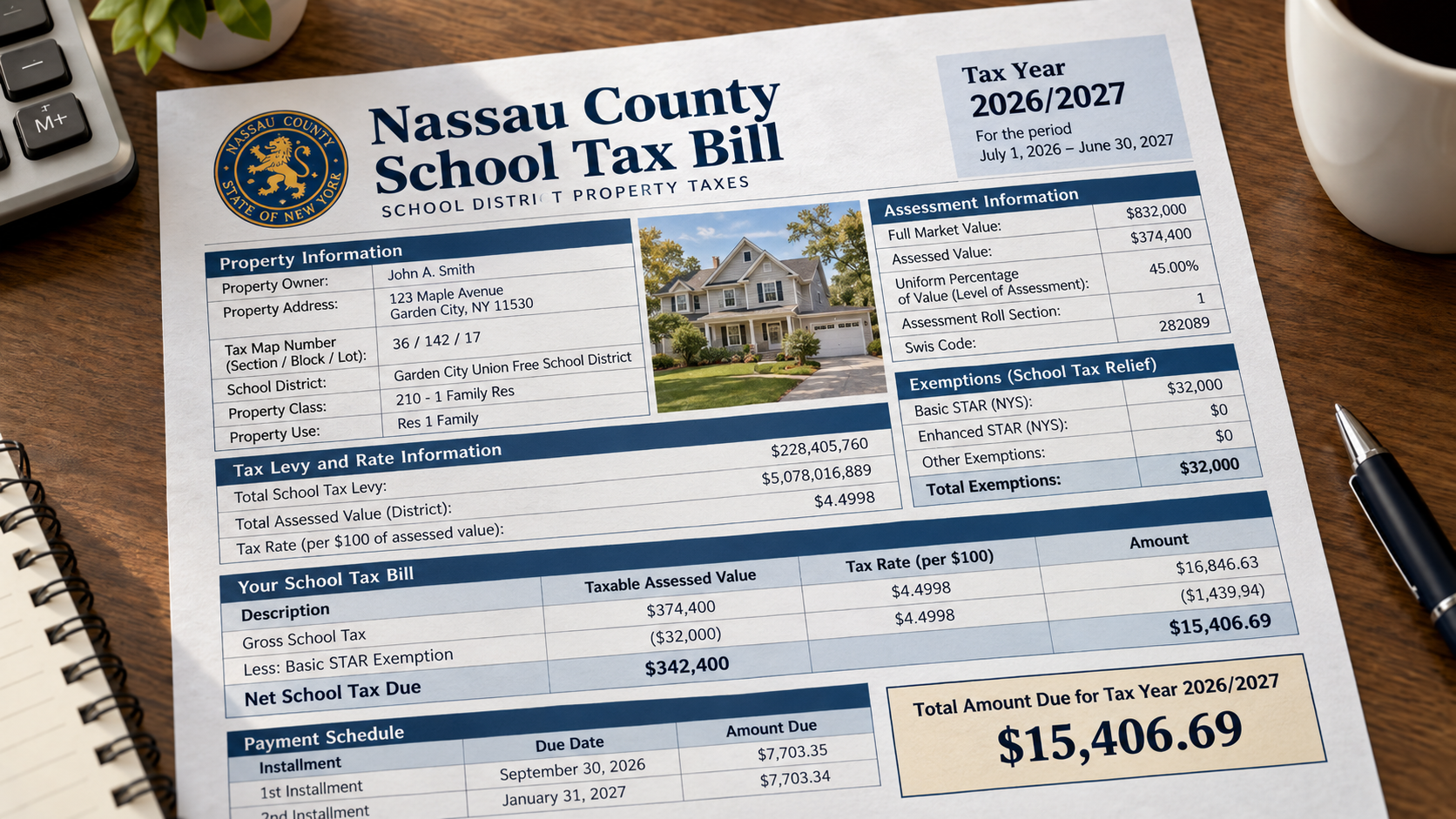
Property taxes and property assessments are related, but they are not the same thing. A tax bill can increase because of changes in school and municipal budgets, tax rates, exemptions, special charges, or the overall tax base—even when a property’s assessed value remains unchanged.
A grievance challenges the property’s assessment. It does not challenge a school budget or guarantee a particular tax saving. The key question is whether the taxable assessment is excessive or unequal under applicable law.
If your bill changed and you are unsure why, read
Why Did My Taxes Go Up If My Property's Assessed Value Didn't Increase?
When should you review your property assessment?
A closer review may make sense when:
1. The market value implied by the assessment appears higher than the property’s realistic value.
2. The property has condition problems, functional limitations, vacancy, or other issues that may not be reflected in the assessment.
3. A recent arm’s-length purchase price is materially below the value suggested by the assessment.
4. An income-producing property has experienced changes in rent, expenses, occupancy, or market conditions.
5. You do not understand whether a tax increase came from the assessment or from another part of the bill.
A well-supported grievance may rely on comparable sales, appraisal evidence, the property’s condition and location, or income and expense information for commercial and rental property. The right evidence depends on the property and the basis of the challenge.
For an overview, see
How The New York Property Tax Grievance Process Works.
Review the assessment before the filing deadline
Property owners should not wait until a tax bill arrives to investigate an assessment. By that point, the filing period for the applicable assessment roll may already have passed.
For Suffolk County towns, Grievance Day generally falls on the third Tuesday in May. Starting early provides time to evaluate the property, review available market information, and prepare the filing properly.
Check BFC’s
Property Tax Grievance Filing Calendar
and confirm the current date before relying on any deadline. Note, all deadlines should be confirmed annually with the local assessor.
How Blodnick, Fazio & Clark helps property owners
Property owners may file a grievance themselves, but determining whether a claim is supportable—and presenting the right valuation evidence—can be difficult.
Blodnick, Fazio & Clark provides attorney-led representation for homeowners, landlords, investors, and commercial property owners throughout Suffolk County and New York. We review the assessment, evaluate the relevant property and market information, prepare the filing, and handle the grievance process for our clients.
Our experience includes single-family homes, condominiums and cooperative communities, apartment buildings, mixed-use properties, shopping centers, office buildings, and industrial properties, and everything in between.
Find out whether your Suffolk County property may be overassessed
Your assessment may be fair. It may also be based on a value that does not accurately reflect your property. A timely review can help you understand the difference before the next filing deadline.
Request a complimentary property-tax analysis today. There is no obligation, and no legal fee unless BFC secures tax relief.
-
Request your free analysis today
- Call the Suffolk office at
(631) 669-6300
-
View the locations we serve
-
Learn how the grievance process works
This article is for general informational purposes and is not legal advice. Filing a grievance does not guarantee a reduction. Prior results do not guarantee a similar outcome. This website contains attorney advertising.
Tax Grievance FAQ
When is Suffolk County Grievance Day?
For Suffolk County towns, Grievance Day is generally the third Tuesday in May. Procedures and dates can change, so confirm the current deadline with the relevant town assessor before filing.
Can filing a Suffolk County tax grievance raise my assessment?
In Suffolk County, the Board of Assessment Review may lower an assessment or keep it the same, but not increase it as its determination on the grievance.
Does a higher tax bill mean my property is over-assessed?
Not necessarily. A tax bill can rise because of tax rates, budgets, exemptions, special charges, or other factors even when the assessment does not change. A grievance focuses on whether the property’s assessment is excessive or unequal.
Can I file a property tax grievance without an attorney?
Yes. A property owner may file without an attorney. Professional representation can help evaluate the claim, prepare valuation evidence, manage deadlines, and advise on further review when appropriate.
How much can a Suffolk County tax grievance save?
There is no universal amount. Any saving depends on the assessment reduction, tax rates, exemptions, and the property’s facts. No representative can guarantee a particular result.
This blog was Reviewed by
Steven M. Fink, Esq., a New York property-tax grievance attorney with nearly 15 years of experience. Last updated July 2026.